
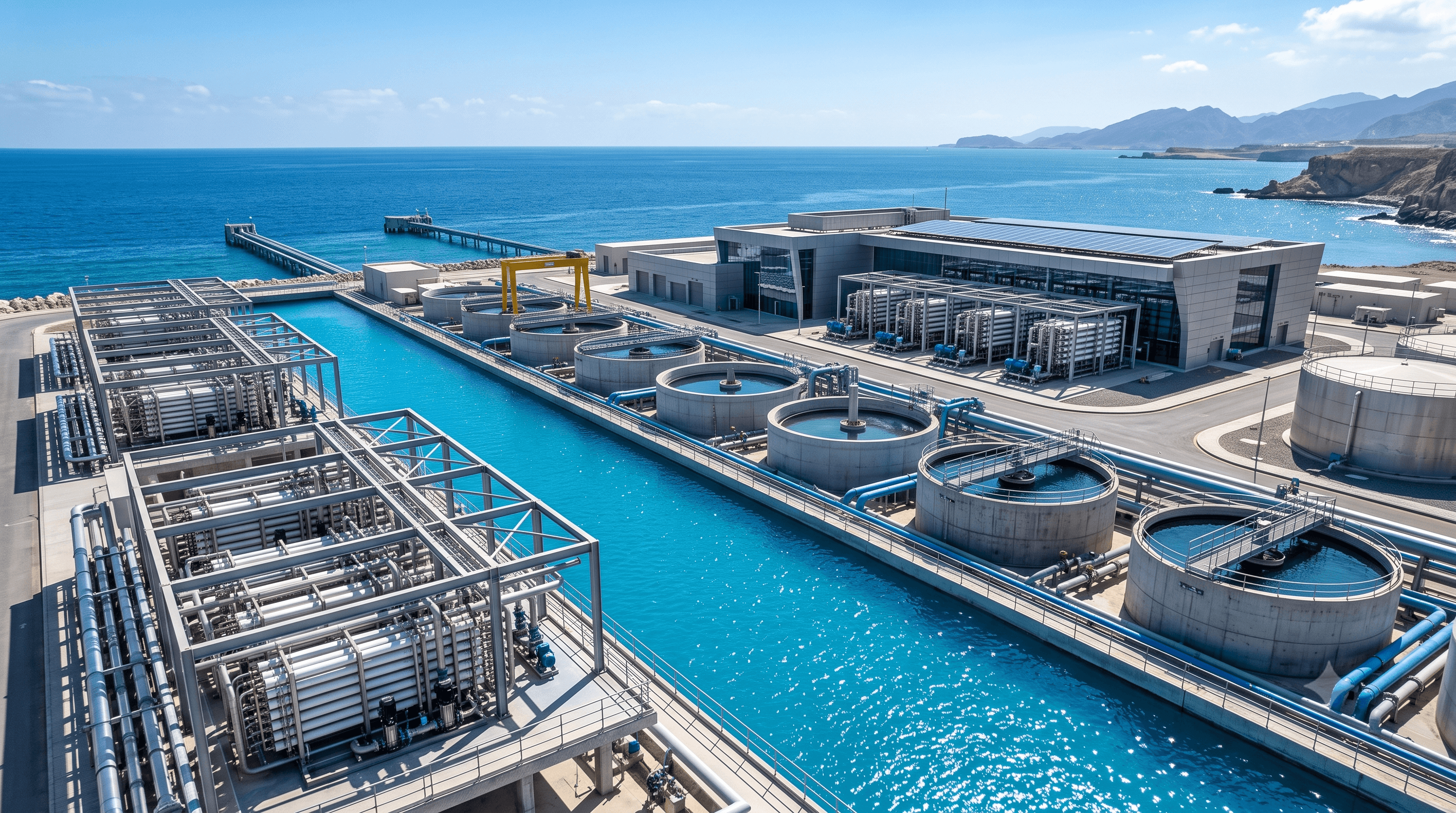
Pumping and desalination are your biggest energy decision.
Water systems are, economically, giant flexible loads with built-in storage — reservoirs and tanks. Running pumps and desal on demand schedules instead of the price curve leaves that flexibility unused.
One economic decision engine, applied across the entire energy value chain — from oil & gas and power generation to renewables, storage, grids and hydrogen.
Water can wait hours; energy prices can't. Storage is your arbitrage.
Desalination is energy priced in water — schedule it like a trade.
Reservoir head is stored energy. Dispatch it like a battery.
Water and energy costs move together. Optimize them together.
Three decision-gap patterns in water & energy infrastructure
Pumps run on demand, not on price
Filling reservoirs during expensive hours when the same volume could be pumped off-peak is a pure timing loss — the water is identical, the cost isn't.
Desalination as an unmanaged flat load
Desal plants draw enormous steady power. Modulating output against price — within contractual water obligations — recovers cost without shorting supply.
Storage never used as an energy buffer
Reservoirs and tanks are energy storage in disguise. Pump-fill them cheap, draw them through peaks — most systems never dispatch them this way.
The same engine. Your sector.
Every decision is a transparent, auditable calculation against published market prices. No black box. No fabricated results.
Ingest
Existing asset telemetry via SCADA/EMS or a file upload — no hardware to replace.
Align
Against published market signals — marginal price, scarcity, demand.
Replay
Every decision is replayed against what the economically optimal one would have been that hour.
Quantify
The economic decision gap in your currency — cited to official sources, independently verifiable.
The economic decisions specific to water & energy infrastructure
Pump scheduling to cheap hours
Fill storage off-peak and draw it down through the peaks.
Desalination load-shifting
Modulate desal output against price within water obligations.
Reservoirs as storage
Treat tank and reservoir headroom as dispatchable energy storage.
Peak avoidance
Keep the largest loads out of the demand-charge interval.
A Decision Gap report — for your asset
Baseline — what your asset actually earned against real market prices, hour by hour.
Shadow run — the same decisions replayed with price-first logic.
Decision gap — the difference in OMR, broken down by leak type.
Top 20 actions ranked by OMR — date, hour, action taken vs. recommended.
Recovery roadmap — what captures each leak, with no software lock-in implied.
Frequently asked
Water supply can't be compromised — is that a constraint?
It's a hard constraint we honor. Optimization happens only within your service and storage limits; supply reliability comes first, savings second.
Do we need new hardware?
No. The flexibility is already in your pumps and storage. We read your telemetry and quantify the timing gap.
How much is your water & energy infrastructure leaving on the table?
A pumping schedule written by habit pays the tariff's worst hours. The price curve is published — use it.
Free 7-day diagnostic with a written guarantee — if we find no recoverable value, you pay nothing.